




On 28 March 2026, the Presentation Hall of the Presidium of the National Academy of Sciences of the Republic of Armenia (NAS RA) hosted the launch of the monograph The Rock Art of Armenia, authored by Karen Tokhatyan, Cd. Hist. Sci., Senior Researcher at the Institute of History.
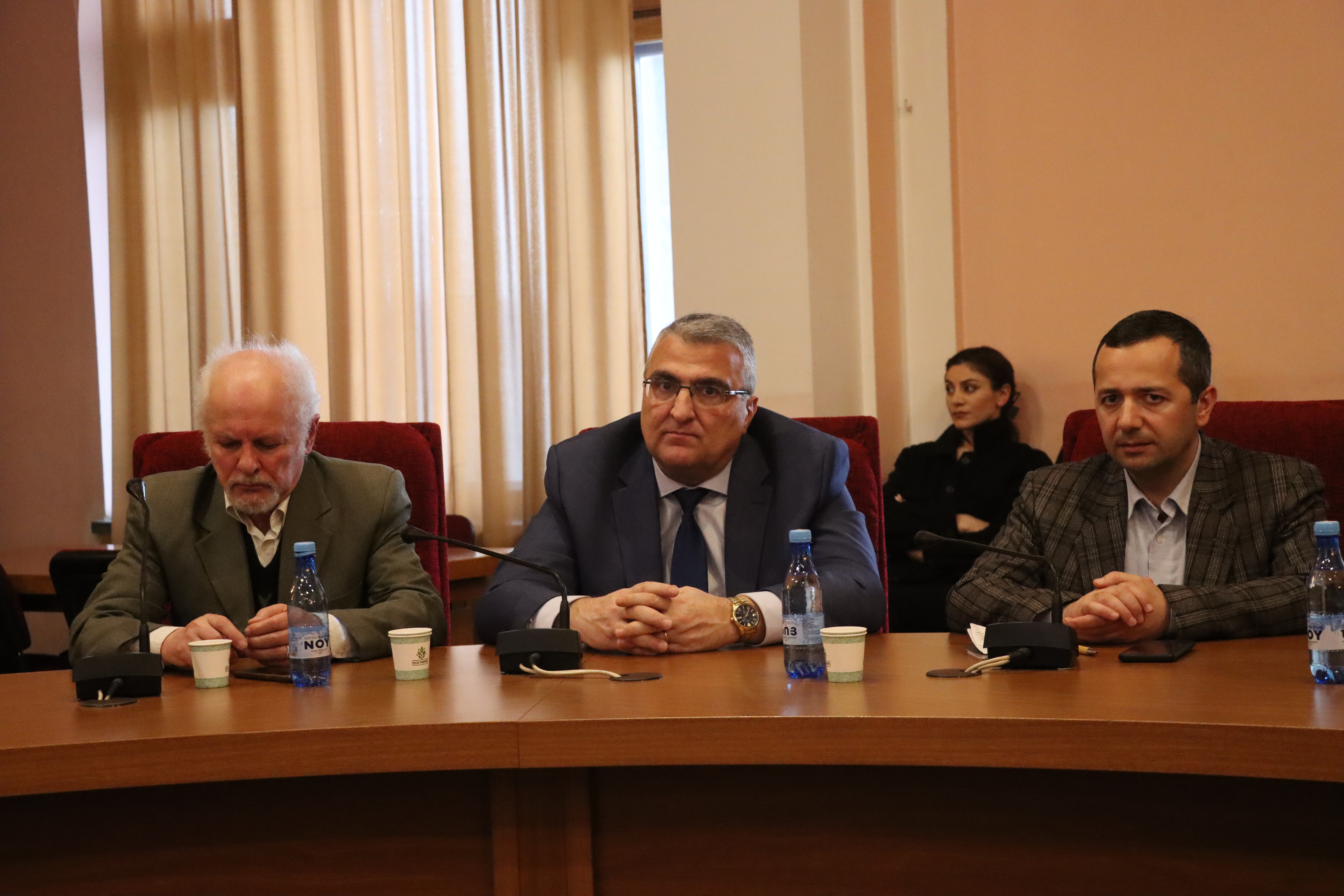
The proceedings were opened by Hamo Sukiasyan, Acting Director of the Institute of History, who emphasised the work’s profound scholarly significance and its extensive iconographic corpus. It was noted that the volume was published through a grant provided by the Pan-Armenian Foundation for the Financing of Armenological Studies.
In presenting the monograph, Karen Tokhatyan remarked that the work synthesises approximately 140 years of the history of discovery and study of Armenian petroglyphs. The research scrutinises the content, functions, and typologies of rock art, while providing a rigorous analysis of their semantics. Furthermore, employing a comparative methodology, the author explores the multifaceted links between these ancient depictions and various spheres of Armenian culture. He also addressed the pivotal contributions made by researchers from the late 19th and throughout the 20th centuries. According to the author, the monograph is the culmination of nearly three decades of dedicated scholarship. The scholar’s interest in the subject dates back to 1977, though his research assumed a systematic, scientific character following his appointment to the Institute of History in 1994. The primary findings were initially consolidated within scholarly articles and a candidate thesis before being expanded and published as this comprehensive monograph.
The scholarly merit of the work was further appraised in speeches delivered by several prominent figures, including Academician Ashot Melkonyan, Chief Researcher at the Institute of History; Harutyun Vanyan, Head of the Department of Preservation of Historical and Cultural Monuments (Ministry of ESCS); Khachik Harutyunyan, Director of the Scientific Research Centre of Historical and Cultural Heritage; Arsen Bobokhyan, Director of the Institute of Archaeology and Ethnography; Areg Mikaelyan, Director of the Byurakan Astrophysical Observatory; Gnel Nalbandyan, Editor-in-Chief of Newmag Publishing; Karen Khachatryan, Deputy Director of the Institute of History; Academician-Secretary Ruben Harutyunyan of the Division of Natural Sciences (NAS RA); Gohar Vardumyan, Leading Researcher of the Department of Ancient History; and Mikayel Badalyan, Head of the same department.
Concluding the event, Karen Tokhatyan expressed his gratitude to the speakers and the Institute of History for the successful organisation of the monograph’s presentation.